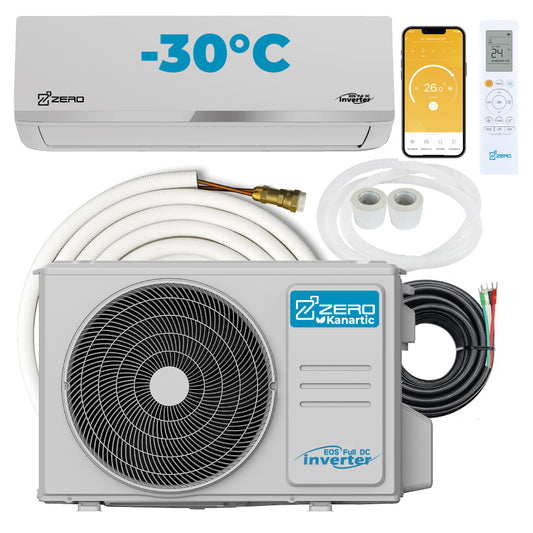

Heat pump vs. electric baseboard heater: a complete comparison for Quebec (2026)
Reading time: 9 minutes
In Quebec, electric baseboard heaters are ubiquitous. They are installed in more than 70% of homes. But with rising electricity rates and new heat pump technologies, more and more homeowners are asking themselves: is it time to switch to a heat pump?
This guide honestly compares the two systems to help you make the best decision.
Understanding the fundamental difference
Electric baseboard heater: energy conversion
An electric baseboard heater converts electricity into heat using a resistance element. For every 1 kWh of electricity consumed , you get exactly 1 kWh of heat . That's 100% efficiency, which sounds excellent... but it's not the maximum possible.
Heat pump: energy transfer
A heat pump doesn't create heat—it moves it from the outside to the inside. For every 1 kWh of electricity consumed , it can transfer 2 to 4 kWh of heat . That's an efficiency of 200% to 400%.
In summary: The heat pump uses electricity more intelligently.
Detailed comparison
| Criteria | Electric baseboards | Wall-mounted heat pump |
|---|---|---|
| Efficiency | 100% (COP 1.0) | 250-350% (COP 2.5-3.5) |
| Purchase cost | $50-150/baseboard | $1,900-$4,000/unit |
| Installation cost | $100-200/baseboard | $0 (DIY) or $1,500-3,000 (pro) |
| Annual heating cost* | $2,200-$2,800 | $900-$1,400 |
| Air Conditioning | Not included | Included |
| Lifetime | 20-30 years old | 15-20 years old |
| Interview | Almost nothing | Monthly filter cleaning |
| Noise | Silent | Slightly audible (40 dB) |
| Comfort | Localized heat, dry air | Even heat, filtered air |
| Wall space | Occupies the lower part of the walls | Up high, it frees up space |
*Estimates for a 1500 sq ft house in Quebec, Hydro-Québec rates 2024.
Calculation of real savings
Concrete example: 1,200 sq ft house in Montreal
Current situation with baseboards:
- Winter consumption: approximately 15,000 kWh
- Cost at tariff D ($0.075/kWh average): $2,250/year
With a heat pump (average COP of 2.5):
- Winter consumption: approximately 6,000 kWh
- Cost: $900/year
- Annual savings: $1,350
Return on investment
| Scenario | Initial cost | Savings/year | Return on investment |
|---|---|---|---|
| DIY 12000 BTU Heat Pump | $2,450 | $1,350 | 1.8 years |
| Heat pump + professional installation | $4,500 | $1,350 | 3.3 years |
After the return on investment: You save $1,350 each year for 12-17 years. Over the lifetime of the heat pump, that's $15,000 to $20,000 in savings.
The hidden advantages of the heat pump
1. Air conditioning included
A heat pump is reversible: it heats in winter AND cools in summer. A portable or window air conditioner costs $300-$600 and uses a lot of electricity. With a heat pump, that's included.
Added value: $300-600 + savings on summer air conditioning.
2. Air filtration
Heat pumps continuously filter the air, capturing dust, pollen, and allergens. For people with allergies or asthma, this is a major advantage that baseboard heaters cannot offer.
3. Dehumidification
In air conditioning mode, the heat pump naturally dehumidifies the air. No need for a separate dehumidifier in summer.
4. Zone control
A wall-mounted heat pump allows you to heat/cool a specific area. No need to heat the whole house if you're spending the evening in the living room.
5. Intelligent control
With the WiFi app, program your heating remotely, create schedules, and monitor your energy consumption. Try doing that with baseboard heaters!
The advantages of electric baseboard heaters
Let's be honest — baseboards also have advantages:
1. Low initial cost
If you are building new or completely renovating, baseboards are cheaper to buy and install.
2. No maintenance
The skirting boards have no moving parts. They function for 20-30 years without intervention.
3. Total silence
The baseboards are completely silent (except for the slight "tick" of thermal expansion).
4. Independence of the zones
Each baseboard is independent. If one fails, the others continue to function.
5. No outdoor unit
No need for outdoor space, no aesthetics to consider.
Who should choose what?
A heat pump is ideal if:
- You pay over $1,500/year for electric heating
- You also want air conditioning
- You have an open-plan space (living room/kitchen/dining room)
- Are you ready to do a DIY installation or pay a pro?
- You have space for the outdoor unit
- You appreciate intelligent control and programming
Baseboards remain relevant if:
- You have several small, enclosed rooms (bedrooms)
- Your initial budget is very limited
- You are a tenant (no permanent change)
- Absolute silence is essential (recording studio)
- You don't have space for an outdoor unit
The best approach: Hybrid
For most Quebec homes, the optimal solution is a hybrid :
- Heat pump in the main living areas (living room, kitchen, office)
- Baseboards retained in bedrooms and bathrooms
Why this approach?
- The heat pump covers 60-70% of your heating needs in the areas where you spend the most time.
- The baseboards serve as a supplement in the bedrooms (they are lowered at night anyway).
- Reduced initial cost (1-2 heat pumps instead of a complete system)
- Maximum flexibility
Example of a hybrid configuration
Typical 3-bedroom house:
- 18,000 BTU heat pump in the living room/kitchen (open concept) — Covers ~60% of heating needs
- Existing baseboards in all 3 bedrooms and the bathroom — Additional lighting
- Result: Savings of 40-50% on total heating
Smooth transition: Where to begin?
You don't have to change everything at once. Here's a gradual plan:
Phase 1: A heat pump for the main space
Install a heat pump in your living room/kitchen. This is generally where you spend most of your waking hours. Immediate savings of 30-40%.
Phase 2: Evaluate after a winter
See the impact on your bills. Most people are pleasantly surprised and want to continue.
Phase 3 (optional): Add zones
If you want to maximize savings, add a second heat pump or a multi-zone system for the bedrooms.
FAQ
Can I remove my baseboards after installing a heat pump?
We recommend keeping them as supplemental heating for very cold days (-25°C and below). You can lower them to 15°C — they will only activate when needed.
Can a heat pump heat my whole house?
Yes, with the right sizing and possibly a multi-zone system. For large houses or complex configurations, several units may be necessary.
What if my heat pump breaks down in the middle of winter?
That's why we keep the baseboard heaters! They take over automatically. Modern heat pumps are reliable, but having a backup is reassuring.
Will baseboards soon be banned in Quebec?
There is no planned ban for existing residences. However, new construction is increasingly geared towards more efficient solutions, and electricity rates continue to rise.
Conclusion
Electric baseboard heaters have served Quebecers well for decades. But with modern heat pumps certified for cold climates, there is now an alternative that can cut your heating costs in half or even by two-thirds , while also providing air conditioning.
The hybrid approach — heat pump for main spaces, baseboards retained for supplemental heating — offers the best of both worlds: significant savings, reasonable investment, and peace of mind.