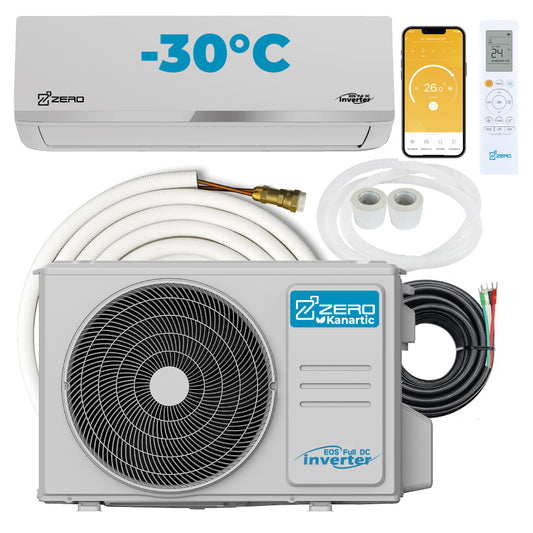

Heat pump at -30°C: myth or reality? Winter performance in Canada
Reading time: 10 minutes
"A heat pump doesn't work in real cold." You've probably heard that before. Fifteen years ago, it was true. Today? It's a myth.
Modern heat pumps, designed for cold climates, can efficiently heat down to -30°C . But how is this possible? And more importantly, is it really cost-effective in Quebec? Here's everything you need to know.
How can a heat pump provide heat when it's -30°C outside?
It's counterintuitive: how do you extract heat from the air when it's -30°C? The answer lies in physics.
The basic principle
A heat pump doesn't "create" heat—it moves it. Even at -30°C, outside air contains thermal energy. The refrigerant in the heat pump has a very low boiling point (around -40°C for R410A, even lower for R454B). It can therefore absorb heat from the cold air and transfer it indoors.
What has changed: Inverter technology
Older heat pumps had an "on/off" compressor — either at full power or off. They quickly lost efficiency below -10°C.
Our modern heat pumps use a variable-speed inverter compressor . Advantages:
- The compressor adjusts its speed according to the need
- Maintains a stable temperature without short cycles
- May "grow" stronger in very cold weather
- Efficiency maintained at low temperature
The "Cold Climate" certification
Energy Star certified heat pumps for cold climates must meet strict criteria:
- Guaranteed operation down to a minimum of -25°C
- Heating capacity of at least 70% of the nominal capacity at -25°C
- Superior efficiency (HSPF) compared to standard models
Kanartic ZERO heat pumps are Energy Star cold climate certified and tested down to -30°C.
Real performance: the figures
Let's get down to specifics. Here's what you can expect from a modern heat pump in cold weather:
Heating capacity according to temperature
| Outside temperature | Relative capacity | Approximate COP* |
|---|---|---|
| +7°C | 100% | 4.0 - 4.5 |
| 0°C | 90-95% | 3.5 - 4.0 |
| -10°C | 80-85% | 2.8 - 3.2 |
| -20°C | 65-75% | 2.2 - 2.6 |
| -25°C | 55-65% | 1.8 - 2.2 |
| -30°C | 45-55% | 1.5 - 1.8 |
*COP (Coefficient of Performance): A COP of 2.0 means that for 1 kWh of electricity consumed, you get 2 kWh of heat.
What do these numbers mean?
Even at -30°C, with a COP of 1.5, your heat pump produces 50% more heat than an electric baseboard heater for the same electricity consumption.
The real question isn't "does it work at -30°C?" but rather "how many days a year does it reach -30°C?"
The climate reality of Quebec
In Montreal, on average:
- Days below -20°C: approximately 10-15 per year
- Days below -25°C: approximately 3-5 per year
- Days below -30°C: 0-2 per year
Conclusion: 95% of the time, your heat pump operates at high efficiency. On the few days of extreme cold, it still works—just a little less efficiently.
Using a heat pump as the main heating source: is it realistic?
Yes, but with a smart approach.
Recommended strategy for Quebec
Most experts recommend a "heat pump + auxiliary heating" approach:
- Above -15°C (90% of winter): The heat pump does all the work.
- Between -15°C and -25°C: The heat pump is working hard, perhaps with a little extra help.
- Below -25°C (a few days/year): The heat pump + auxiliary heating share the load.
Supplemental heating options
- Existing electric baseboards: Keep them! They will serve as a free "backup".
- Integrated heating element: Some heat pumps have an integrated electric element that activates automatically.
- Wood or pellet stove: Popular option for cottages and rural homes.
Intelligent sizing
Rather than oversizing your heat pump to cover 100% of your needs at -30°C (which is very expensive), size it to cover:
- 80-90% of your needs at the design temperature (approximately -20°C to -25°C in Quebec)
- Let the space heater cover the extreme peaks
Result: better average efficiency, reasonable purchase cost, year-round comfort.
Optimizing your heat pump in extreme cold
1. Defrost mode
In cold, damp weather, frost forms on the outdoor unit. This is normal. Your heat pump has an automatic defrost cycle that briefly reverses the airflow to melt the frost.
What you will notice:
- The indoor unit blows lukewarm air or stops blowing for 2-10 minutes.
- You can hear a "swoosh" when the cycle begins
- Steam may come out of the outdoor unit
That's normal — don't touch anything.
2. Do not block the outdoor unit
After a snowstorm:
- Clear the snow around the outdoor unit
- Make sure the fan is not blocked
- Never cover the unit with a tarpaulin in winter (it needs to breathe).
3. Stable setpoint temperature
Avoid large temperature fluctuations:
- Do not lower the temperature drastically at night (no more than 2-3°C).
- Inverter heat pumps are more effective at maintaining a stable temperature than at compensating for a large temperature difference.
4. Use the appropriate "heating" mode
In very cold weather, use the "Heating" mode rather than the "Auto" mode. The Auto mode may switch to air conditioning if the sun temporarily warms the room.
Cost comparison: Heat pump vs. other systems
For an average 1500 sq ft house in Quebec:
| Heating system | Estimated annual cost* | Efficiency |
|---|---|---|
| Electric baseboards | $2,200 - $2,800 | 100% (COP 1.0) |
| Natural gas furnace | $1,400 - $1,800 | 92-96% |
| Fuel oil | $2,500 - $3,500 | 80-85% |
| Wall-mounted heat pump | $900 - $1,400 | 250-350% (COP 2.5-3.5) |
*Estimates based on 2024 Hydro-Québec rates and a typical winter. Your costs may vary depending on insulation, habits, and rates.
Potential savings: $800 to $1,500 per year compared to electric baseboard heaters.
FAQ: Heat pump and extreme cold
Will my heat pump shut off if it gets too cold?
Kanartic ZERO heat pumps continue to operate down to -30°C. Below this temperature (extremely rare in Quebec), the unit will gradually lose its efficiency.
Does the defrost cycle consume a lot of energy?
Defrosting accounts for approximately 5-10% of winter energy consumption. This is included in HSPF efficiency calculations, so it's already factored in.
Should I cover my outdoor unit in winter?
No! The outdoor unit must operate year-round. A tarp would block airflow and could cause damage. Heat pumps are designed to withstand the elements.
Why is steam coming out of my outdoor unit?
This is the defrost cycle in action. The frost is melting and evaporating. This is normal and a sign that your system is working correctly.
Conclusion: -30°C is possible
Modern heat pumps for cold climates are no longer a compromise—they are a complete heating solution for Quebec. With proper installation and supplemental heating for those few days of extreme cold, you can:
- Reduce your heating costs by 40-60%
- Enjoy air conditioning in the summer (included)
- Help reduce your carbon footprint