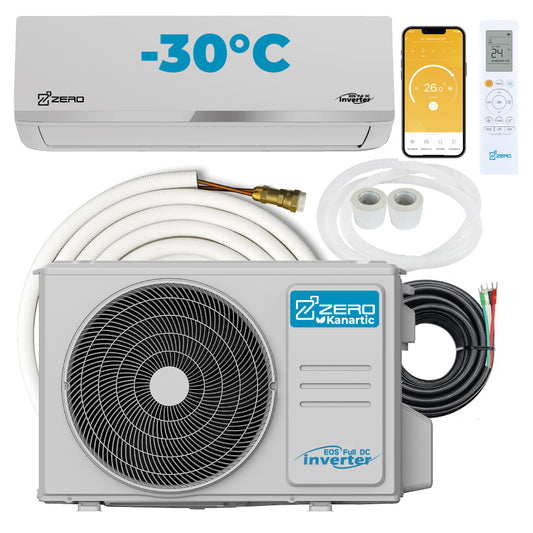
Reading time: 10 minutes Choosing the right heat pump capacity is the most important decision for your project. A unit that's too small won't heat adequately. A unit that's too large will waste energy and wear out prematurely. This guide helps you make the right choice, whether it's for a room, an entire floor, or the whole house. Understanding BTUs What is a BTU? BTU stands for British Thermal Unit. It is the unit of measurement for heating or cooling capacity. The higher the BTU rating, the larger the space the appliance can heat or cool. In simple terms: 9,000 BTU = small room or small apartment 12,000 BTU = average room or standard apartment 18,000 BTU = large room or small bungalow 24,000 BTU = very large room or average house Quick guide by area Area Recommended BTUs Kanartic Model Ideal for 300 - 500 sq ft 9,000 BTU ZERO 9K Master bedroom, office, small condo 500 - 750 sq ft 12,000 BTU ZERO 12K Living room, open kitchen, apartment 750 - 1,100 sq ft 18,000 BTU ZERO 18K Large living room, open area, small bungalow 1,100 - 1,500 sq ft 24,000 BTU ZERO 24K Large open area, full ground floor 1,500+ sq ft or multi-room Multi-zone Z-PRO 2 or 3 zones Complete house, multiple floors Factors that influence the choice 1. Insulating your home Insulation is the most important factor after surface area: Excellent insulation (new house, triple-glazed windows): Use the lower end of the BTU range Good insulation (1990s-2000s house, renovated): Use the middle of the range Average insulation (house from the 70s-80s): Add 15-20% Poor insulation (old house, wooden chalet): Add 25-35% 2. Ceiling height Standard ceilings (8 ft) : Normal calculation Ceilings of 9-10 ft : Add 10-15% Cathedral ceilings (12+ ft) : Add 20-30% 3. Exposure and windows Large south/west-facing windows : No more air conditioning needed in summer (+10%) Few windows or north-facing orientation : More heating required in winter (+10%) Single-glazed windows : Add 15-20% 4. Number of occupants and devices Each person generates approximately 400-600 BTUs of heat Active cooking, computers, lighting = extra heat For air conditioning, take these heat sources into account. 5. Space configuration Open area : A single unit can cover the entire space Enclosed rooms : Air circulation is limited; consider multi-zone systems. Open staircase : Hot air rises; cold air descends 1 zone vs Multi-zone: How to choose? 1-zone system (one indoor unit) Ideal for: Open plan (living room-kitchen-dining room) Apartments and condos Heating/cooling a main area Limited budget Benefits : Lower purchase cost Easier installation Less maintenance Limitations: Cannot control multiple rooms individually Air has difficulty reaching enclosed rooms. Multi-zone system (2-3 indoor units) Ideal for: Houses with multiple floors Houses with enclosed rooms Independent control of each area Different needs depending on the room (office vs bedroom) Benefits : Customized temperature per zone More efficient for complex houses One single outdoor unit for multiple indoor units Considerations: Higher initial cost More complex installation No more refrigerated lines to run Multi-zone configurations explained 2 Zones — 18,000 BTU Total Typical configuration: Zone 1: Living Room/Kitchen — 12,000 BTU Zone 2: Master Room — 6,000 BTU Ideal for: 2-bedroom condos, small bungalows 2 Zones — 27,000 BTU Total Typical configuration: Zone 1: Ground Floor — 18,000 BTU Zone 2: Floor — 9,000 BTU Ideal for: Medium-sized 2-story houses 3 Zones — 18,000 or 27,000 BTU total Typical configuration: Zone 1: Living Room — 9,000 BTU Zone 2: Master Room — 6,000 BTU Zone 3: Office or 2nd bedroom — 6,000 BTU Ideal for: Houses with several enclosed rooms, home offices Common scenarios and recommendations Scenario 1: Open 650 sq ft condo Location: Modern condo, open concept living room/kitchen, 1 closed bedroom Recommendation: 12,000 BTU, 1 zone installed in the living room. The bedroom will benefit from the circulating air if the door remains open, or you keep the baseboard heaters for the bedroom. Scenario 2: Bungalow 1,100 ft² Location: 1980s bungalow, open concept + 3 bedrooms Options: Option A: 18,000-24,000 BTU, 1 zone in the living room. Baseboard heaters retained in the bedrooms as supplemental heating. Option B: Multi-zone 2-3 zones for complete control. Our suggestion: Option A for the best cost/benefit ratio. Scenario 3: 2-story house, 1,800 sq ft Situation: Recent house, open ground floor, 3 bedrooms upstairs Recommendation: Multi-zone 27,000 BTU Zone 1: Ground Floor — 18,000 BTU Zone 2: Upstairs Hallway — 9,000 BTU (room doors open) Alternative: Two independent 1-zone systems (one per floor). Scenario 4: 700 sq ft Chalet Situation: Wooden chalet, average insulation, open main area Recommendation: 12,000 BTU, 1 zone — Slightly oversized to compensate for insulation. Wood stove as backup. Sizing errors to avoid ❌ Mistake: Choosing too big "just in case" Problem: An oversized heat pump is experiencing "short cycling"—it quickly reaches the desired temperature, shuts off, and then restarts. This short cycle: Use the compressor prematurely Does not dehumidify well in summer Creates temperature variations Wastes energy ❌ Mistake: Choosing too small to save money Problem: An undersized heat pump: Operates constantly at full power Never reaches the desired temperature in extreme weather Consumes more electricity Wears out faster ✓ The right choice: Size correctly A properly sized heat pump operates in long, regular cycles, maintains a stable temperature, and offers optimal efficiency. 16-foot vs. 25-foot line: Which one to choose? Each Kanartic model is available with 16-foot (5m) or 25-foot (7.6m) lines. 16-foot (5m) line Sufficient for most installations Outdoor unit close to the wall of the indoor unit Ideal for condos, apartments, small houses Slightly lower price 25-foot (7.6m) line For installations where the outdoor unit is far away Houses where the ideal location is on the other side More flexibility in placement Chalets with special configurations Tip: Measure the distance between the intended location of the indoor unit and the outdoor unit. Add 2-3 feet for curves and play. Choose accordingly. Use our BTU calculator For an accurate calculation taking into account all factors (surface area, insulation, windows, ceilings, climate), use our online calculator: Calculate my BTUs → Summary: Which model to choose? Your situation Our recommendation Small condo or room ZERO 9K DIY Standard apartment or living room ZERO 12K DIY (the most popular) Large open area or small bungalow ZERO 18K DIY Very large open space ZERO 24K DIY Multi-story or multi-room house Z-PRO Multi-zone Cottage ZERO 12K or 18K DIY View all models Need help choosing? Not sure which one to choose? Contact our team via chat. Describe your space and we'll guide you to the right model.