Heat Pump for Tiny Homes, Trailers and Cabins
A tiny home, a trailer set up year-round at a campground or a small cabin in the woods have one thing in common: a small volume to heat, often with limited electrical service and little room for a heating system. A small-capacity mini-split heat pump fits naturally. This page explains what works well, what calls for precautions and how to choose a Kanartic DIY system for these spaces.
The challenges of small spaces
- Small volume, big swings: a few degrees too warm or too cold is felt immediately. A door opened in January chills the whole space.
- Condensation: cooking, showers and breathing in a small volume raise humidity, which condenses on windows and in cold corners.
- Limited electrical service: a tiny home or trailer doesn't always have electrical capacity comparable to a house.
- Thin walls: in a trailer or cabin, the structure offers little to fasten a heavy unit to.
- Oversizing: a unit that is too powerful for a small volume starts and stops constantly, which hurts comfort and dehumidification.
Why a DIY mini-split is a good fit
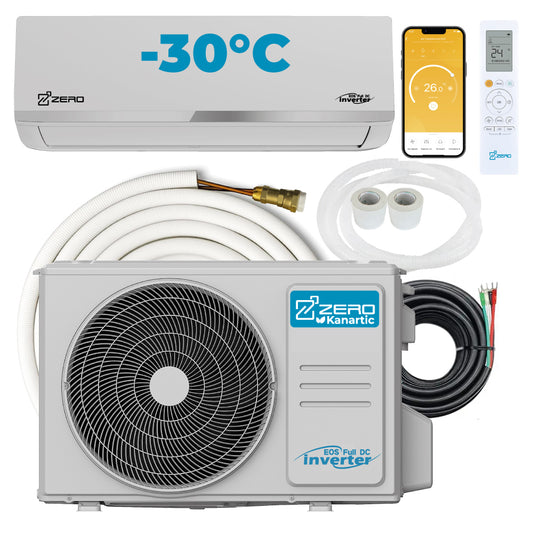
The inverter compressor modulates its output instead of running all-or-nothing: it handles small loads well. The wall-mounted indoor unit takes no floor space, and at 22 dB it stays discreet in a space where you sleep a few feet from the unit. In summer, cooling removes the humidity that builds up quickly in a small volume. Kanartic models heat down to −30°C and below, without shutting off below −30°C.
For owners who build their own tiny home or cabin, the DIY format avoids bringing in a refrigeration technician to a remote area: the outdoor unit is pre-charged with refrigerant, the line sets are vacuumed at the factory and connect with quick connectors. Shipping is free everywhere in Canada, although a contribution may be requested for some remote regions.
What works, and what doesn't
- Tiny home on a foundation or on a stationary trailer: a very good use, as long as the unit is fastened to a solid structure.
- Park model or seasonal trailer set up permanently: a good use if the trailer no longer moves. A wall-mounted heat pump is a fixed appliance: a trailer that travels regularly subjects the connections and units to vibrations they aren't designed for.
- Cabin or hunting camp: a good use if the power supply is reliable. Off-grid, a generator or solar system must be sized for start-up and continuous operation; read how to connect a heat pump to solar panels.
Which system to choose
In a small space, the main risk is going too big. Calculate your needs with the free BTU calculator, entering the actual insulation of the walls, floor and roof.
- One-room tiny home, trailer or cabin: the ZERO DIY 9,000 BTU, 16 ft line set is the most common choice. A Standard version is available for installation by a refrigeration technician.
- Larger or poorly insulated tiny home, or cabin in a very cold region: the ZERO DIY 12,000 BTU, if the calculator confirms it.
- Tiny home with an enclosed loft: a single well-placed unit is often enough, since warm air rises to the loft. A multi-zone system is only useful if the rooms are truly separate.
Installation points
Mounting the indoor unit
Fasten the mounting plate to studs or add wood furring behind the wall finish. In a trailer, check that the wall can carry the unit's weight. Place the unit so the air doesn't blow directly on the bed.
Outdoor unit
Set it on a 4-leg ground stand anchored to the ground rather than on a trailer frame, to limit vibration transmitted indoors. Keep it above the snow and sheltered from what falls off the roof. A 16 ft line set is almost always enough; an aluminum line set cover protects it.
Condensate
Direct the drain outside, away from foundations or tires. If the unit is on an interior wall, use a Kanartic ultra-slim condensate pump. In winter, make sure the outdoor unit's defrost water doesn't freeze on a walkway.
Electrical
Have the capacity of the electrical service checked before buying: it is often the deciding factor between the 9,000 and 12,000 BTU models. The dedicated circuit and disconnect must be installed by an electrician.
All the steps are described in the complete DIY installation guide, and the tools you need are listed in a dedicated article.
Rebates
LogisVert covers completed dwellings that are habitable year-round and located in Québec, including mobile homes and cottages. A camping trailer or a cabin that isn't habitable year-round does not qualify. In addition, the 9,000 BTU single-zone wall unit is not eligible, because its outdoor unit is below the 12,000 BTU/h threshold. If your tiny home is an eligible dwelling and the calculator justifies a 12,000 BTU unit, read DIY heat pump and LogisVert rebate. Outside Québec, see the rebates by province and our Rebates page.
Frequently asked questions
Can a wall-mounted heat pump be installed in a trailer?
Yes, if the trailer is set up permanently. A wall-mounted heat pump is a fixed appliance and isn't designed for the vibrations of a trailer that travels regularly.
What capacity for a tiny home?
Often the smallest in the range, but it depends on insulation and region. The BTU calculator helps avoid oversizing, which is common in small spaces.
Is a heat pump enough for a cabin in winter?
In an insulated cabin with a reliable power supply, yes: Kanartic models heat down to −30°C and below. Plan a backup if the power can fail.
Does the 9,000 BTU model qualify for LogisVert?
No. LogisVert requires an outdoor unit of at least 12,000 BTU/h. The 9,000 BTU is still a good choice for a small space when the rebate is not the goal.
Do I need an electrician for a tiny home?
Yes. The dedicated circuit, disconnect and verification of the electrical service capacity must be done by an electrician.
See also


Economic Heating
In cold regions, using your appliance in heating mode can save you a lot of money and even a return on investment in 2-3 years.

Economy air conditioning
The right choice of power allows you to better adapt your device to your space
-
Kanartic ZERO Mini Split Heat Pump 24000 BTU 23 SEER High Efficiency 5m-16ft
Regular price $2,395.00 CADRegular priceUnit price per$3,436.00 CADSale price $2,395.00 CADSale -
DIY Mini Split ZERO Heat Pump 24000 BTU 23 SEER High Efficiency 7.6M-25ft
Regular price $3,499.00 CADRegular priceUnit price per$4,435.00 CADSale price $3,499.00 CADSale -
DIY Mini Split ZERO Heat Pump 24000 BTU 23 SEER High Efficiency 5M-16ft
Regular price $3,399.00 CADRegular priceUnit price per$4,435.00 CADSale price $3,399.00 CADSale -
DIY Mini Split ZERO Heat Pump 12000 BTU 25 SEER High Efficiency 8M-25ft
Regular price $2,449.00 CADRegular priceUnit price per$3,685.00 CADSale price $2,449.00 CADSale -
DIY Mini Split ZERO Heat Pump 18000 BTU 23.5 SEER High Efficiency 5M-16ft
Regular price $2,895.00 CADRegular priceUnit price per$4,060.00 CADSale price $2,895.00 CADSale -
DIY Mini Split ZERO Heat Pump 18000 BTU 23.5 SEER High Efficiency 8M-25ft
Regular price $2,995.00 CADRegular priceUnit price per$4,060.00 CADSale price $2,995.00 CADSale -
DIY Mini Split ZERO Heat Pump 9000 BTU 26.4 SEER High Efficiency 5M-16ft
Regular price $2,199.00 CADRegular priceUnit price per$3,435.00 CADSale price $2,199.00 CADSale -
DIY Mini Split ZERO Heat Pump 9000 BTU 26.4 SEER High Efficiency 8M-25ft
Regular price $2,299.00 CADRegular priceUnit price per$3,435.00 CADSale price $2,299.00 CADSale -
Kanartic ZERO Mini Split Heat Pump 12000 BTU 25 SEER High Efficiency 8m-25ft
Regular price $1,795.00 CADRegular priceUnit price per$2,811.00 CADSale price $1,795.00 CADSale -
Kanartic ZERO Mini Split Heat Pump 9000 BTU 26.4 SEER High Efficiency 8m-25ft
Regular price $1,695.00 CADRegular priceUnit price per$2,561.00 CADSale price $1,695.00 CADSale