Heat Pump for Garage and Workshop
A garage or workshop is rarely designed for comfort: a cold concrete slab, a big door that lets heat escape, uneven insulation and stifling heat in July. Yet that is often where you tinker, fix the car or set up a home gym. A mini-split heat pump heats and cools this space without ductwork and without touching the house's heating system. This page explains how to choose and install a Kanartic DIY system in a garage or workshop.
Typical garage and workshop problems
- Losses through the garage door: a poorly insulated or poorly sealed door is the main heat leak.
- Cold slab: concrete stays cold for a long time and chills the air at floor level.
- Occasional use: you may only heat on weekends, which calls for a unit that can bring the temperature up quickly.
- Dust and sawdust: a woodworking shop clogs an indoor unit's filters quickly.
- Summer heat: a south-facing garage or one under a dark roof quickly becomes unusable in summer.
Why a DIY mini-split is a good fit
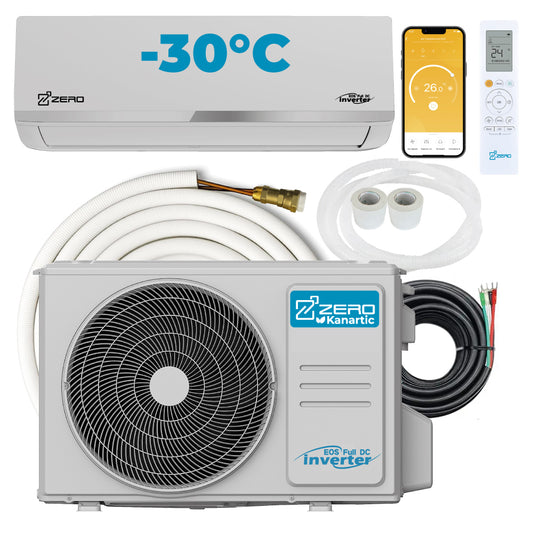
A wall-mounted heat pump heats and cools with the same unit. Its inverter compressor modulates its speed: it can hold an economical base temperature during the week and warm up quickly when you arrive. Kanartic models heat down to −30°C and below, without shutting off below −30°C, which matters in a garage where the temperature drops fast at night.
The DIY format is designed for this kind of project: the outdoor unit is pre-charged with R454B refrigerant, the line sets are vacuumed at the factory and connect with quick connectors. You don't need a vacuum pump or refrigeration tools. A garage also has a practical advantage: the exterior wall is often easy to drill and the line set can stay short.
Which system to choose for your garage
Capacity depends on insulation, the door, ceiling height and your region. Don't rely on a rule of thumb: run the numbers with the free BTU calculator, which accounts for these factors. Then use the range as follows:
- Insulated single garage or small workshop: the ZERO DIY 12,000 BTU, 16 ft line set, or its 25 ft line set version if the outdoor unit is farther away.
- Double garage or high ceiling: the ZERO DIY 18,000 BTU or the ZERO DIY 24,000 BTU, 25 ft line set, depending on the calculator's result.
- Garage + workshop + office: a multi-zone system gives one indoor unit per room, each with its own temperature. See the Z-PRO DIY 18,000 BTU 2 zones or the Z-PRO DIY 36,000 BTU 3 zones.
- You'd rather have it installed: Standard versions, such as the ZERO 24,000 BTU Standard, are meant for installation by a refrigeration technician.
Insulate first: door weatherstripping, door and ceiling insulation. Each improvement reduces the capacity you need, and therefore the cost of the unit and of electricity.
Garage-specific installation points
Indoor unit location
Mount the unit high on a wall that blows toward the work area, away from the garage door so warm air doesn't escape every time it opens. In a dusty workshop, keep it away from the saw and dust collector, and clean the filters more often than in a house. Respect the clearances in the installation manual and don't place the unit above flammable products or gas cans.
Outdoor unit and snow
Raise the unit above the snow with a stainless steel wall bracket or a 4-leg ground stand, sheltered from snow and ice falling off the roof. Avoid the driveway where snow is blown or shovelled.
Condensate
In cooling mode, the indoor unit produces water. If the drain can't run by gravity to the outside, add a Kanartic ultra-slim condensate pump. Never let the drain discharge onto a slab where it could freeze.
Electrical
The heat pump needs a dedicated circuit and a disconnect near the outdoor unit. In a garage, this sometimes means a subpanel. This work must be done by an electrician.
For everything else, follow the complete DIY installation guide.
Rebates: what to know for a garage
LogisVert excludes detached buildings, including a garage separate from the house, as well as indoor units installed outside the insulation envelope. An attached garage therefore does not qualify if it isn't heated and insulated like the rest of the dwelling. If in doubt, check with Hydro-Québec before buying. To understand the DIY + commissioning process, read DIY heat pump and LogisVert rebate and see our Rebates page.
Frequently asked questions
Can a heat pump heat an uninsulated garage?
It will produce heat, but much of it will escape. At a minimum, insulate the door and ceiling before sizing the unit with the BTU calculator.
Can I keep the garage above freezing all winter?
Yes. The inverter compressor can hold a low temperature continuously, and Kanartic heat pumps heat down to −30°C and below.
Does workshop dust damage the unit?
It mainly clogs the filters. Place the unit away from dust sources and clean the filters regularly to maintain airflow and efficiency.
Does a detached garage qualify for LogisVert?
No. The LogisVert guide excludes detached buildings such as a garage, shed or storage building.
Can I do the electrical wiring myself?
No. The electrical connection, dedicated circuit and disconnect must be done by an electrician. You can do the mechanical installation yourself.
See also


Economic Heating
In cold regions, using your appliance in heating mode can save you a lot of money and even a return on investment in 2-3 years.

Economy air conditioning
The right choice of power allows you to better adapt your device to your space
-
Kanartic ZERO Mini Split Heat Pump 24000 BTU 23 SEER High Efficiency 5m-16ft
Regular price $2,395.00 CADRegular priceUnit price per$3,436.00 CADSale price $2,395.00 CADSale -
DIY Mini Split ZERO Heat Pump 24000 BTU 23 SEER High Efficiency 7.6M-25ft
Regular price $3,499.00 CADRegular priceUnit price per$4,435.00 CADSale price $3,499.00 CADSale -
DIY Mini Split ZERO Heat Pump 24000 BTU 23 SEER High Efficiency 5M-16ft
Regular price $3,399.00 CADRegular priceUnit price per$4,435.00 CADSale price $3,399.00 CADSale -
DIY Mini Split ZERO Heat Pump 12000 BTU 25 SEER High Efficiency 8M-25ft
Regular price $2,449.00 CADRegular priceUnit price per$3,685.00 CADSale price $2,449.00 CADSale -
DIY Mini Split ZERO Heat Pump 18000 BTU 23.5 SEER High Efficiency 5M-16ft
Regular price $2,895.00 CADRegular priceUnit price per$4,060.00 CADSale price $2,895.00 CADSale -
DIY Mini Split ZERO Heat Pump 18000 BTU 23.5 SEER High Efficiency 8M-25ft
Regular price $2,995.00 CADRegular priceUnit price per$4,060.00 CADSale price $2,995.00 CADSale -
DIY Mini Split ZERO Heat Pump 9000 BTU 26.4 SEER High Efficiency 5M-16ft
Regular price $2,199.00 CADRegular priceUnit price per$3,435.00 CADSale price $2,199.00 CADSale -
DIY Mini Split ZERO Heat Pump 9000 BTU 26.4 SEER High Efficiency 8M-25ft
Regular price $2,299.00 CADRegular priceUnit price per$3,435.00 CADSale price $2,299.00 CADSale -
Kanartic ZERO Mini Split Heat Pump 12000 BTU 25 SEER High Efficiency 8m-25ft
Regular price $1,795.00 CADRegular priceUnit price per$2,811.00 CADSale price $1,795.00 CADSale -
Kanartic ZERO Mini Split Heat Pump 9000 BTU 26.4 SEER High Efficiency 8m-25ft
Regular price $1,695.00 CADRegular priceUnit price per$2,561.00 CADSale price $1,695.00 CADSale