Heat Pump for Additions, Sunrooms and New Rooms
You're adding a room to the house, enclosing a porch or turning a three-season sunroom into a livable room. Very soon the same question comes up: how do you heat and cool this new space without redoing the heating for the whole house? Extending ductwork or adding baseboards isn't always the best answer. A mini-split heat pump dedicated to the new room is often simpler, more efficient and more comfortable.
Typical problems with an addition or sunroom
- Large glazed areas: a sunroom loses a lot of heat at night and overheats in the afternoon sun.
- Existing system already maxed out: the furnace or central heat pump wasn't sized for the extra floor area, and added ducts often leave the room poorly balanced.
- Floor on piers or on a slab: the underside of the room is exposed to the cold, which makes the floor uncomfortable.
- Seasonal use: a three-season sunroom is used from April to October, and you'd like to enjoy it longer.
Why a DIY mini-split is a good fit
The new room gets its own system, with its own remote and its own setting, without touching the existing heating. The inverter compressor adapts to rapid load changes: it slows down when the sun warms the sunroom and speeds up when the temperature drops. In summer, the same unit cools, making a glazed room usable during a heat wave.
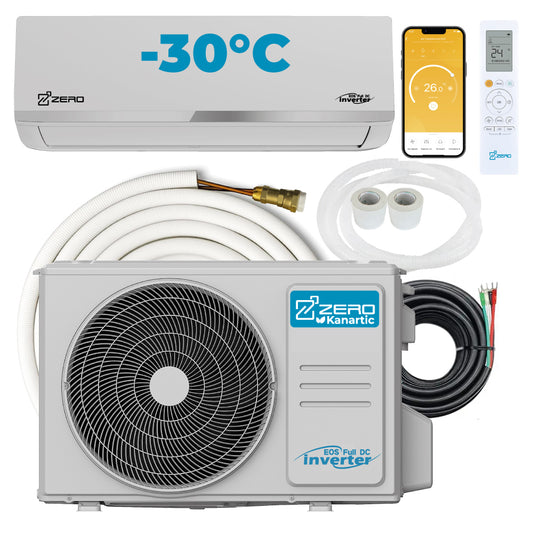
In an addition under construction, this is also the right time to plan the route of the line set and drain before closing the walls. The Kanartic DIY system arrives with a pre-charged outdoor unit, factory-vacuumed line sets and quick connectors: the contractor can close the walls while you finish installing the heat pump.
Insulate before you heat: the sunroom rule
A three-season sunroom often has thin walls, single glazing and an uninsulated floor. A heat pump will keep it pleasant in fall and spring, but it won't turn an uninsulated space into an economical four-season room. If you want year-round use, plan for sealed double-glazed windows, floor and roof insulation, then size the unit. This step also affects rebate eligibility (see below).
Which system to choose
Glazed area, orientation and insulation change the needs significantly. Use the free BTU calculator and enter the number and size of windows: it is the factor that matters most in a sunroom.
- Standard added room (bedroom, playroom, office): the ZERO DIY 12,000 BTU, eligible for LogisVert with commissioning.
- Glazed sunroom or large family room: the ZERO DIY 18,000 BTU, 25 ft line set or the ZERO DIY 24,000 BTU, depending on the calculation.
- Multi-room addition: a multi-zone system such as the Z-PRO DIY 36,000 BTU 2 zones or the Z-PRO DIY 36,000 BTU 3 zones serves each room with a single outdoor unit.
- Professional installation: Standard versions, such as the ZERO 18,000 BTU Standard, are meant for installation by a refrigeration technician.
Installation points
Indoor unit location
In a sunroom, mount the unit on the solid wall (often the wall shared with the house) and direct the airflow along the windows, where the air cools. Avoid placing it facing a sofa or table: air should circulate without blowing directly on people.
Line set route and outdoor unit
Since the room often projects from the house, the outdoor unit can go against the new wall or under the sunroom, if clearance and defrost water drainage allow. An offset bracket helps when the wall isn't straight, and the line set cover kit gives a clean finish on new siding. The 16 ft and 25 ft DIY line sets cover most cases; the outdoor unit's charge is sized for a line set up to 30 ft.
Condensate
If the drain can run down to the outside, gravity is enough. Otherwise, the Kanartic ultra-slim condensate pump fits behind the unit.
Electrical
Plan the dedicated circuit together with the addition's wiring. This work, like the outdoor disconnect, must be done by an electrician.
For detailed steps, follow the complete DIY installation guide.
Rebates
An insulated addition that is habitable year-round is part of the dwelling: it can qualify for LogisVert in Québec with an outdoor unit of at least 12,000 BTU/h and commissioning by an RBQ-licensed company. An uninsulated three-season sunroom is generally outside the insulation envelope, which the program excludes. Details are in DIY heat pump and LogisVert rebate and on our Rebates page.
Frequently asked questions
Can a three-season sunroom be heated all winter?
It is possible if it is insulated and has sealed double-glazed windows. Without insulation, the heat pump will mainly extend the season in spring and fall.
Is it better to extend the existing ductwork?
Rarely. The existing system isn't sized for the new room, and long duct branches often leave the room colder than the others. A dedicated unit is controlled independently.
When should the heat pump be installed during the work?
Plan the route of the line set, drain and electrical circuit before closing the walls. The unit itself can be installed once the finishing is done.
Does the added room qualify for LogisVert?
Yes, if it is insulated, habitable year-round and equipped with an eligible system of at least 12,000 BTU/h, with an invoice from an RBQ-licensed company.
Is air conditioning useful in a sunroom?
Yes, that is often where it is used most: a heavily glazed room overheats quickly in the sun. The same heat pump heats in winter and cools in summer.
See also


Economic Heating
In cold regions, using your appliance in heating mode can save you a lot of money and even a return on investment in 2-3 years.

Economy air conditioning
The right choice of power allows you to better adapt your device to your space
-
Kanartic ZERO Mini Split Heat Pump 24000 BTU 23 SEER High Efficiency 5m-16ft
Regular price $2,395.00 CADRegular priceUnit price per$3,436.00 CADSale price $2,395.00 CADSale -
DIY Mini Split ZERO Heat Pump 24000 BTU 23 SEER High Efficiency 7.6M-25ft
Regular price $3,499.00 CADRegular priceUnit price per$4,435.00 CADSale price $3,499.00 CADSale -
DIY Mini Split ZERO Heat Pump 24000 BTU 23 SEER High Efficiency 5M-16ft
Regular price $3,399.00 CADRegular priceUnit price per$4,435.00 CADSale price $3,399.00 CADSale -
DIY Mini Split ZERO Heat Pump 12000 BTU 25 SEER High Efficiency 8M-25ft
Regular price $2,449.00 CADRegular priceUnit price per$3,685.00 CADSale price $2,449.00 CADSale -
DIY Mini Split ZERO Heat Pump 18000 BTU 23.5 SEER High Efficiency 5M-16ft
Regular price $2,895.00 CADRegular priceUnit price per$4,060.00 CADSale price $2,895.00 CADSale -
DIY Mini Split ZERO Heat Pump 18000 BTU 23.5 SEER High Efficiency 8M-25ft
Regular price $2,995.00 CADRegular priceUnit price per$4,060.00 CADSale price $2,995.00 CADSale -
DIY Mini Split ZERO Heat Pump 9000 BTU 26.4 SEER High Efficiency 5M-16ft
Regular price $2,199.00 CADRegular priceUnit price per$3,435.00 CADSale price $2,199.00 CADSale -
DIY Mini Split ZERO Heat Pump 9000 BTU 26.4 SEER High Efficiency 8M-25ft
Regular price $2,299.00 CADRegular priceUnit price per$3,435.00 CADSale price $2,299.00 CADSale -
Kanartic ZERO Mini Split Heat Pump 12000 BTU 25 SEER High Efficiency 8m-25ft
Regular price $1,795.00 CADRegular priceUnit price per$2,811.00 CADSale price $1,795.00 CADSale -
Kanartic ZERO Mini Split Heat Pump 9000 BTU 26.4 SEER High Efficiency 8m-25ft
Regular price $1,695.00 CADRegular priceUnit price per$2,561.00 CADSale price $1,695.00 CADSale