
How does a heat pump inverter compressor work?
The compressor is the heart of a heat pump. On modern units such as Kanartic wall heat pumps, it is an inverter compressor, also called a variable-speed compressor. Here is how it works and the 6 things to know about inverter technology.
What the compressor does in a heat pump
A heat pump moves heat using a refrigerant that circulates in a loop between the indoor and outdoor units:
- Evaporation: in the cold coil (the evaporator), the refrigerant absorbs heat from the air and evaporates.
- Compression: the compressor squeezes this gas, raising its pressure and temperature.
- Condensation: in the other coil (the condenser), the hot gas releases its heat to the air and turns back into liquid.
- Expansion: the expansion valve lowers the liquid's pressure and it returns to the evaporator.
In winter, the evaporator is outside and the condenser inside: heat comes in. In summer, a reversing valve swaps the roles: heat goes out.
Inverter or conventional compressor?
A conventional (fixed-speed) compressor has only two states: 100% or off. It starts, reaches the temperature, stops, then restarts when the room cools down. An inverter compressor is driven by an electronic board that varies the frequency of the current sent to the motor. It can run slowly when demand is low and speed up when it is very cold or very hot.
6 things to know about inverter technology
1. Compressor speed adjusts continuously
Output follows the room's real needs, minute by minute, instead of running all-or-nothing.
2. Energy savings
Start-ups are when a compressor uses the most energy. By avoiding on-off cycles and often running at part load, where it is most efficient, an inverter cuts consumption. That is what makes high SEER and HSPF ratings possible (see our SEER and HSPF guide).
3. Steady temperature
No more swings of several degrees: the heat pump holds the set point precisely, without hot blasts or cold drafts.
4. A longer-lasting compressor
Fewer start-ups mean less mechanical and electrical stress. That is why Kanartic warrants its compressors for 10 years (parts: 5 years; in Quebec, the legal warranty of quality also applies).
5. Faster heating and cooling
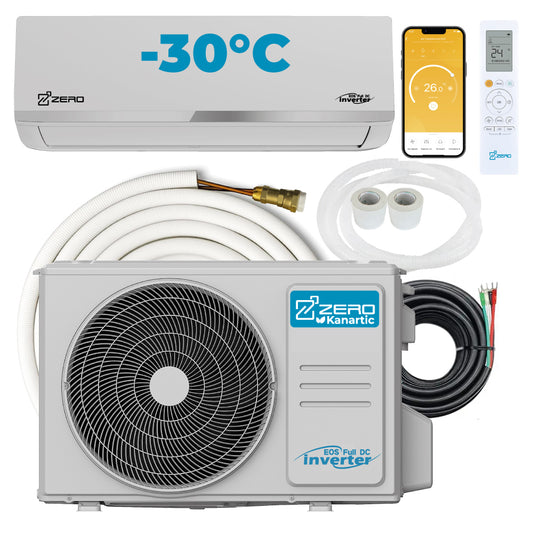
At start-up, the inverter can run at high speed to reach the temperature quickly, then slow down to maintain it. It is also what lets cold-climate models keep strong capacity in extreme cold: Kanartic heat pumps heat down to −30 °C and below (read heat pump at −30 °C).
6. Lower long-term costs
An inverter unit may cost slightly more to buy, but energy savings and a longer life make it more cost-effective over time.
Inverter, quiet operation and dehumidification
At low speed, the compressor and fans are quieter: Kanartic indoor units go down to 22 dB. Long cycles also improve dehumidification in summer, because air spends more time over the cold coil.
Frequently asked questions
Are all Kanartic heat pumps inverter models?
Yes, all ZERO single-zone and Z-PRO multi-zone wall models use an inverter compressor.
Does an inverter compressor run all the time?
It often runs for long periods, but at low speed. That is normal and it is where it is most efficient.
Why does my heat pump stop and restart?
A few stops are normal (set point reached, defrost). If it happens often, read my heat pump stops and restarts, what should I do?
Discover our cold-climate inverter wall heat pumps, shipped free anywhere in Canada.