
How to lower the humidity level in a house with a heat pump?
Excess humidity causes condensation on windows, musty smells, mould and heavy, uncomfortable air. The good news: a wall-mounted heat pump is one of the most effective ways to remove humidity from a home, while cooling it in summer and heating it in winter. Here is how to use it to lower the humidity level.
What humidity level should you aim for?
Indoors, aim for 30% to 50% relative humidity: around 30 to 40% in winter to avoid condensation on windows, and 40 to 50% in summer. Above 60%, mould and dust mites thrive. An inexpensive hygrometer lets you track the level room by room.
Signs your home is too humid
- Fog or droplets on windows in the morning
- Musty smell, especially in the basement
- Black spots in corners, around windows or in the bathroom
- Heavy, sticky air in summer
- Swelling wood, sticking doors
How a heat pump removes humidity
A heat pump does not draw in outdoor air: it treats the air in the room. In cooling or dehumidification mode, the indoor unit's fan pushes air over a very cold coil. The water vapour in the air condenses on the coil, like on a glass of ice water, and the water drains outside through the drain hose. The air that comes out is cooler and drier.
Using dehumidification (DRY) mode
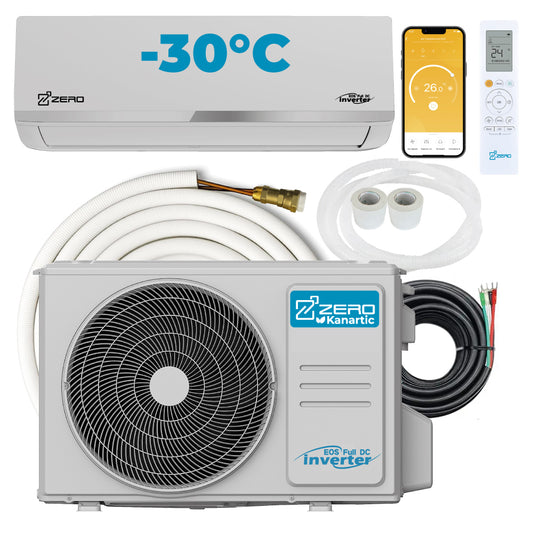
Kanartic heat pumps offer four modes: cooling, heating, dehumidification and fan. In DRY mode (water drop icon), the fan runs at low speed and the compressor modulates its output: the unit removes as much moisture as possible while cooling the room only slightly. It is the ideal mode in mild, humid weather, in spring, in fall or in a basement in summer. All the steps are in our guide how to use the dehumidifier mode of heat pumps.
7 tips to lower humidity
- Pick the right mode: DRY when it is humid but not hot, cooling when it is hot and humid.
- Leave the fan on auto or low: air passes more slowly over the coil and releases more water.
- Size it correctly: an oversized heat pump reaches the set temperature too fast and stops before dehumidifying. See our guide to choosing BTU capacity.
- Keep the filters clean: a clogged filter reduces airflow and efficiency. See how to clean the filters.
- Check the drain: the drain hose must stay clear and sloped. Where water cannot drain by gravity, a condensate pump solves the problem.
- Close doors and windows while the unit is dehumidifying.
- Reduce moisture sources: run the range hood and bathroom fan, vent the dryer outside. In winter, ventilation (air exchanger) is what controls humidity: read air exchanger or heat pump.
Benefits of dehumidifying with a heat pump
- More comfort: drier air feels cooler, so you can set the thermostat a little higher in summer and use less energy.
- Mould prevention: below 50% humidity, mould struggles to grow.
- Better air quality: fewer dust mites and allergens, which helps people with allergies or asthma.
- Protects your home: wood furniture, floors, fabrics and musical instruments suffer less.
- One quiet appliance: no water tank to empty, and Kanartic indoor units are very quiet (22 dB).
Frequently asked questions
Can a heat pump replace a dehumidifier?
For living spaces during the warm season, yes in most cases. In a basement that is very damp all year, a dedicated dehumidifier can still help, especially in cool weather.
How do I remove humidity with a heat pump in winter?
In heating mode, a heat pump does not remove water from the air. In winter, excess humidity is mainly controlled by ventilation: air exchanger, bathroom and kitchen fans. A steady, adequate temperature also helps limit condensation on windows.
Where does the water go?
It drains through the indoor unit's drain hose, usually outside along the refrigerant line.
Does DRY mode use a lot of energy?
No: the inverter compressor runs at low speed and the fan at low speed. It is generally cheaper to run than a portable dehumidifier.
Looking for a heat pump that dehumidifies, cools and heats down to −30 °C and below? Discover our cold-climate wall heat pumps and our DIY models, shipped free anywhere in Canada.